PRISMA Explained: A Beginner’s Guide to Systematic Literature Reviews
PRISMA tells you how to report a systematic review so readers can see exactly how your evidence was found, screened and selected. Here is what it is and how its flow diagram works.
Key takeaways
- PRISMA stands for Preferred Reporting Items for Systematic Reviews and Meta-Analyses.
- It is a reporting guideline: it explains how to report each phase, not how to conduct the review.
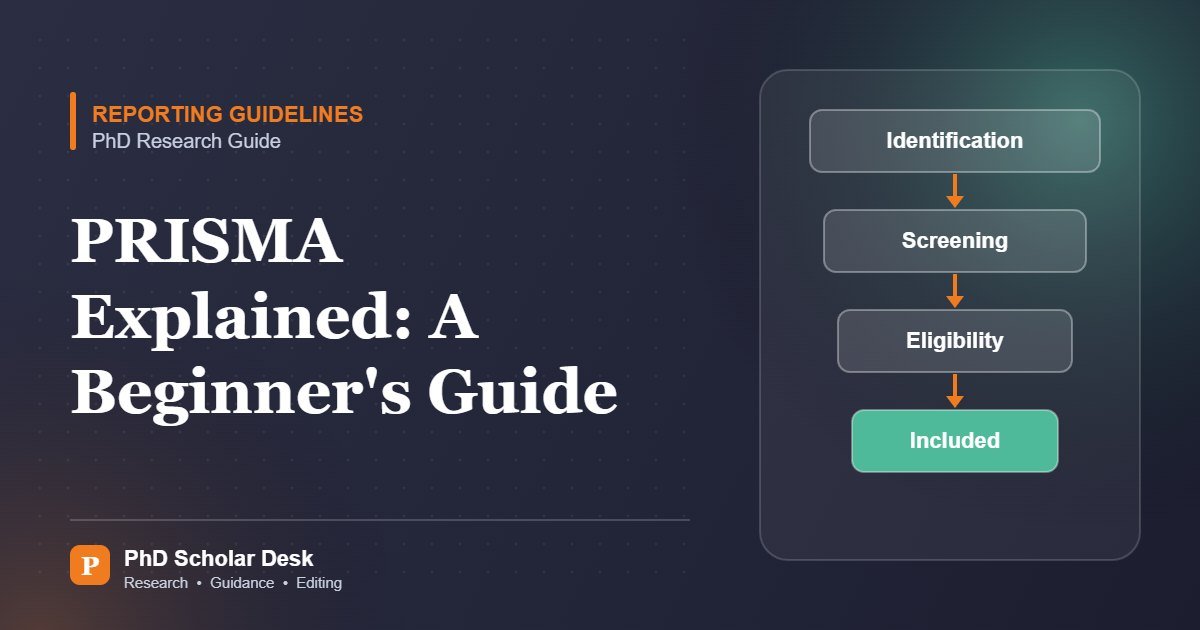
- The PRISMA flow diagram tracks studies through Identification, Screening, Eligibility and Inclusion.
- Recording exclusion reasons at each stage is what makes your review transparent and replicable.
What is PRISMA and why is it important?
If you have started learning about systematic literature reviews, you have probably come across the term PRISMA. It stands for Preferred Reporting Items for Systematic Reviews and Meta-Analyses, an internationally used reporting guideline that helps researchers present their review process in a clear, transparent and consistent way.
PRISMA does not tell you how to carry out a review; for that, see our guide on how to conduct a systematic literature review. Instead, it sets out what to report at each phase, so readers can understand how the evidence was gathered and analysed.
The four stages of the PRISMA flow diagram
The PRISMA flow diagram visually shows how studies move through your review. It follows four stages that make the selection process easy to follow:
Search several databases using suitable keywords, synonyms and Boolean operators, and record how many records each search returns.
Remove duplicate records, then review titles and abstracts. Exclude studies that do not meet your predetermined criteria.
Assess the remaining full-text articles in detail, and record each excluded article with the reason for exclusion.
Show the studies that meet every criterion; these are extracted and used in your evidence synthesis.
This step-by-step flow gives readers a transparent overview of how your final set of studies was selected.
How PRISMA improves research quality
Transparency is one of PRISMA’s biggest advantages. By documenting the databases consulted, keywords, search process, inclusion criteria and reasons for excluding studies, you show readers and examiners exactly what you did.
What to record for a PRISMA-ready report
- Databases searched and the date of each search
- Full search strings and any filters applied
- Number of records at every stage, including duplicates removed
- Inclusion and exclusion criteria
- Reasons for excluding each full-text article
For beginners, PRISMA works as a practical checklist that keeps the review organised from start to finish. Rather than wondering what to include, you follow an established reporting structure that improves clarity, strengthens credibility and increases the chance of producing a high-quality systematic literature review.
Many reporting problems come from missing records rather than a weak review. Our guide to common systematic review mistakes explains how to avoid them.
Need help with your PRISMA flow diagram?
We can help you document your search, screening and selection so your review is transparent, consistent and ready for examiners or journal reviewers.
Keep reading
This guide is for learning and planning. Review methods vary by discipline and university, so always check your programme handbook and supervisor’s expectations. Any work you submit must be your own, with every source properly attributed.

One response
[…] This documentation improves transparency and lets another researcher repeat your review. It also feeds straight into your PRISMA flow diagram. […]