Review Article Writing Services for PhD Scholars
Get expert review article and review paper writing support for Scopus, SCI and SCIE journal publication. PhD Scholar Desk delivers plagiarism-free, PRISMA-compliant, publication-ready manuscripts crafted by subject-matter experts — focused on clearly scoped research assistance.
Whether you need a systematic review, a narrative review, a meta-analysis, or a full literature review for your thesis or journal submission, our writers identify the real research gap in your field, structure the paper the way your target journal expects, and hand you a manuscript you can submit with confidence.

Types of Review Papers We Write
Systematic Review Writing A structured, PRISMA-compliant approach with a defined search protocol, explicit inclusion/exclusion criteria, and a documented screening process. The standard choice when a journal requires methodological rigour and reproducibility.
Narrative Review Writing A broad thematic overview without a fixed search protocol — the right choice for emerging or fast-moving research areas where you need to establish the overall shape of a field quickly.
Literature Review Writing A comprehensive summary of existing literature that situates your own research within its academic context. Used throughout thesis chapters, dissertation introductions, and as standalone journal literature reviews.
Survey Paper Writing An in-depth overview of research trends, methodologies, and advancements in a field, often used in engineering and computer science to map where a sub-discipline is heading.
Scoping Review Maps the volume, nature, and characteristics of existing research on a topic before a deeper systematic review is attempted — useful for identifying how much literature actually exists before committing to a full review.
Meta-Analysis A quantitative technique that statistically combines data from multiple studies to produce stronger, pooled evidence than any single study can offer on its own.
Integrative Review Synthesises findings across different research methodologies — qualitative and quantitative — into one coherent review, ideal when your topic has been studied from multiple methodological angles.
Rapid Review Streamlines the systematic review process to deliver evidence-based insight within a compressed timeline, without abandoning methodological rigour — useful when a journal or supervisor deadline is tight.
Quick Summary: Review Article Writing Services
| Review types covered | Systematic, narrative, literature, survey, scoping, meta-analysis, integrative, rapid reviews |
| Typical length | 5,000–10,000 words |
| Typical references | 50–150 sources |
| Databases used | Scopus, IEEE Xplore, PubMed, ScienceDirect, SpringerLink, Google Scholar, Web of Science |
| Citation styles | APA, MLA, IEEE, Harvard, Vancouver, Chicago, and journal-specific formats |
| Originality | Source attribution and similarity-aware review |
What Is a Review Paper?
A review paper critically analyses and synthesises existing published research on a specific topic, rather than presenting new experimental data. Instead of running new experiments, a review paper identifies research gaps, evaluates the strengths and weaknesses of prior studies, and gives readers a clear, structured picture of where a field currently stands.
- A strong review paper does four things:
- Identifies genuine research gaps rather than restating what is already well established.
- Critically evaluates the methodology and evidence quality of the sources it draws on — not just summarising them.
- Organises findings thematically, so the paper builds an argument rather than reading as a list of “Author A found X, Author B found Y.”
- Positions your research within the field in a way that improves your chances of journal acceptance.
At PhD Scholar Desk, we don’t just write — we strategically position your research. Our process identifies research gaps, analyses 100+ high-quality papers per review, ensures a logical flow and structure, adds critical insight rather than summary, and optimises the manuscript for journal acceptance.

What Makes Our Review Papers Unique?
Identify research gaps
Analyze 100+ high-quality papers
Ensure logical flow and structure
Add critical insights (not just summaries)
Optimize for journal acceptance
Our Review Paper Writing Process
We follow a clear, sequenced process so every review paper is well-researched, critically analysed, and ready for journal submission:
Requirement discussion. We understand your subject, academic level, target journal, and deadline before any writing begins.
Topic selection and research gap analysis. We help you choose a high-impact, feasible topic and confirm there is a genuine, citable gap in the literature.
Literature collection. We gather relevant, credible papers from Scopus, IEEE, PubMed, Springer, and Elsevier — prioritising recent, high-impact sources.
Screening and selection. Sources are screened for credibility and relevance; low-quality or predatory sources are excluded before drafting starts.
Structuring the paper. We organise the manuscript into the sections your target journal expects — Abstract, Introduction, Methodology, Discussion, Conclusion.
Writing and critical analysis. We write with critical evaluation throughout, not simple summarisation — comparing findings, weighing evidence quality, and building toward your stated research gap.
Referencing and formatting. Every citation is formatted to your journal’s specific style (APA, MLA, IEEE, Harvard, Vancouver, or Chicago).
Plagiarism and quality review. The manuscript is checked for originality and reviewed for logical flow before delivery.
Delivery and revision. You receive the completed manuscript along with a plagiarism report; revisions are made based on your feedback
Why Choose PhD Scholar Desk
Clearly defined deliverables and project-specific feedback arrangements
Subject-matter support, not generalist freelancers — writers are matched to your specific research domain
Responsible research support — we work in line with institutional policy; you retain authorship, ownership, and final responsibility for your submitted work
On-time delivery, with your timeline confirmed before work begins
Ideal Word Count for Review Articles
Most peer-reviewed review articles run between 5,000 and 10,000 words, though this varies by journal and review type. A focused narrative review for a specialised journal may be closer to 5,000–6,000 words, while a comprehensive systematic review or meta-analysis for a high-impact journal can extend to 8,000–10,000 words or more. We confirm your target journal’s specific word-count guidelines before drafting begins, so your manuscript is the right length from the first draft.
Difference Between Review Paper & Survey Paper
| Review Paper | Survey Paper |
| Summarizes existing literature | Analyzes trends and evolution |
| Focus on critical evaluation | Focus on classification & comparison |
| Used in academic journals | Used in technical domains |
Disciplines We Cover
- Engineering & Computer Science
- Life Sciences & Medicine
- Management & Business
- Social Sciences & Humanities
- Environmental Science
- Education
Our writers are matched to your specific research domain rather than assigned as generalists.
Databases and Citation Styles We Work With
Literature databases:
Scopus
IEEE Xplore
PubMed
ScienceDirect
SpringerLink
Google Scholar
Web of Science
Citation and reference styles:
APA
MLA
IEEE
Harvard
Vancouver
Chicago
Your specific university or journal format on request
How Many References Should a Review Paper Have?
A typical review paper cites between 50 and 150 references, depending on the scope of the topic and the review type. A narrower narrative review may need 50–80 well-chosen sources, while a systematic review or meta-analysis covering a broad research question often draws on 100–150+ sources identified through a structured search process. We prioritise recent, high-impact, peer-reviewed sources from databases such as Scopus, IEEE Xplore, and PubMed over outdated or low-quality references.
Common Reasons Review Papers Get Rejected
Insufficient critical analysis — summarising sources instead of evaluating and comparing them
No clear research gap — the review doesn’t state what the field doesn’t yet know
Outdated references — leaning on sources more than 10 years old when recent literature exists
Poor thematic organisation — structured paper-by-paper (“Author A found X, Author B found Y”) instead of grouped by theme or finding
Weak or inconsistent methodology — no clear, repeatable search and screening process for systematic reviews
Formatting and citation errors — not matching the target journal’s specific structure and reference style
Scope too broad or too narrow — either impossible to cover thoroughly or too thin to justify a full review
Plagiarism or excessive paraphrasing concerns — insufficient original critical voice
We check every manuscript against this list before delivery, specifically to avoid the single most common reason journals send review papers back for revision: “insufficient critical analysis.
Meet Our Review Article Writing Experts
Your manuscript is prepared by qualified researchers who publish themselves, not by generic content writers.

Biplab Paul
Data science & analytics lead
Machine learning, statistical analysis and data visualisation for quantitative research, predictive modelling and hypothesis testing.
Published: Lead author, IJFMR 2026 (wheat rust genomics). Co-author, IJNRD 2026 (NHANES poliovirus study).
View profile
Kaushik Bhattacharyya
Data analytics & NLP
3 years supporting research projects, thesis work, statistical analysis and data interpretation.
Published: Co-author, IJNRD 2026 (NHANES poliovirus study).
View LinkedIn
Suman Guchait
Engineering expert & technical specialist
3 years in engineering analysis, technical documentation and engineering research, with data tools for reporting.
Published: Co-author, IJNRD 2026 (NHANES poliovirus study).
View LinkedIn
Nabhanita Kundu
Biology expert
Biology and life-sciences support, research writing and manuscript preparation.

Kushal Chanda
Finance expert
Finance and accountancy assignments and research support.
Published: Co-author, EPRA IJMR paper on anchoring and loss aversion in human–LLM decisions.

Anushka Dutta
Research writer
Microbiology and life-sciences research article drafting and thesis writing support.

Poulami Biswas
Research writer
Anthropology and social-science research article drafting, editing and publication support.
Papers by Our Writers
Peer-reviewed papers our research team has written and published. Preview the first page, then download the full PDF to check the quality yourself.
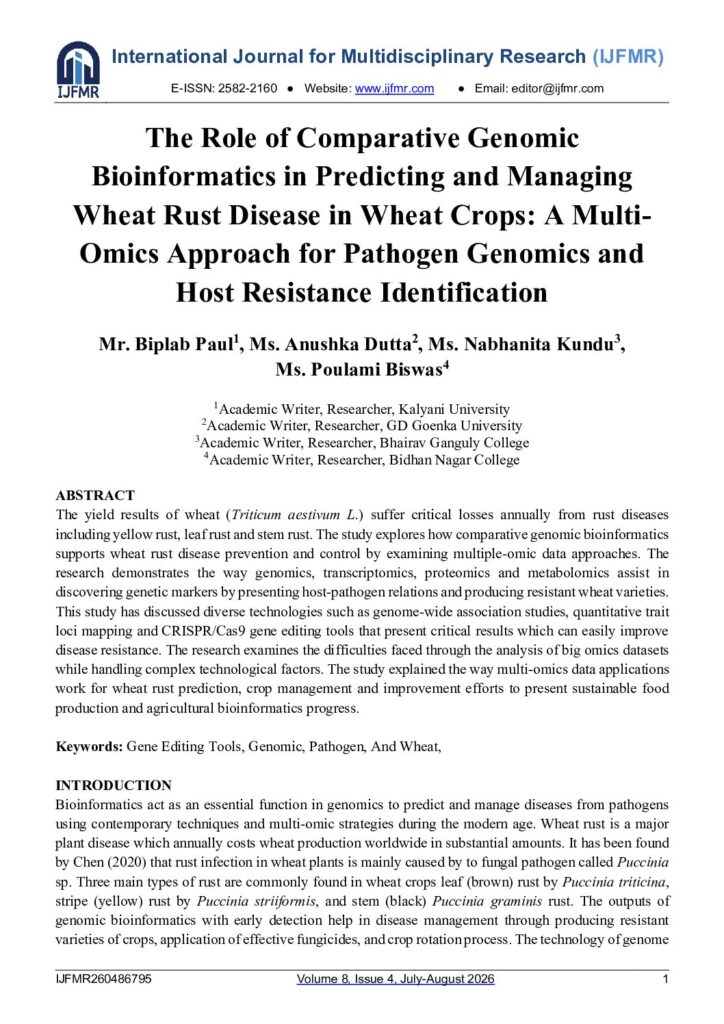 PDF preview · page 1
IJFMR · VOL. 8, ISSUE 4 (JULY–AUGUST 2026)
The Role of Comparative Genomic Bioinformatics in Predicting and Managing Wheat Rust Disease in Wheat Crops: A Multi-Omics Approach
Paper ID 86795 · DOI 10.36948/ijfmr.2026.v08i04.86795
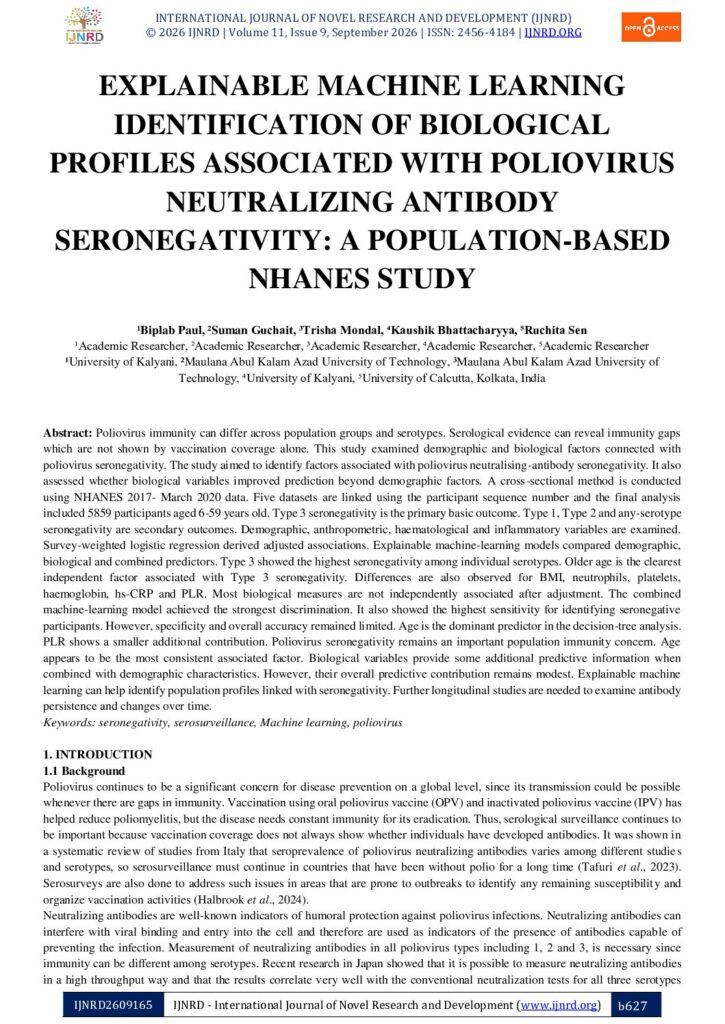 PDF preview · page 1
IJNRD · VOL. 11, ISSUE 9 (SEPTEMBER 2026)
Explainable Machine Learning Identification of Biological Profiles Associated with Poliovirus Neutralizing Antibody Seronegativity: A Population-Based NHANES Study
Paper ID IJNRD2609165 · Registration ID 328506
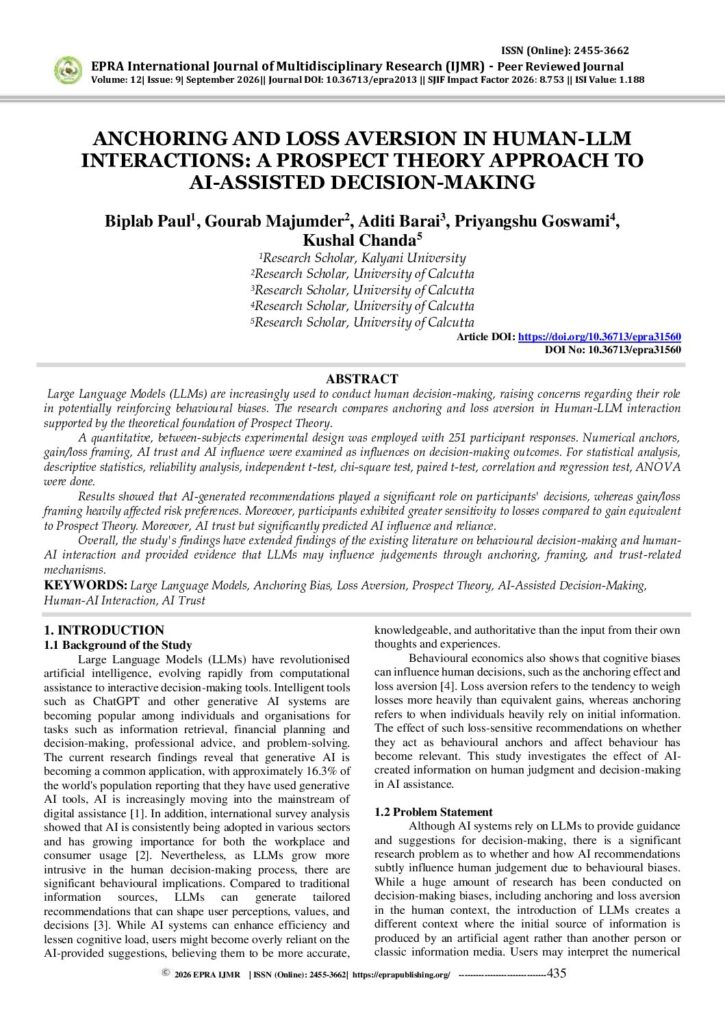 PDF preview · page 1
EPRA IJMR · VOL. 12, ISSUE 9 (SEPTEMBER 2026)
Anchoring and Loss Aversion in Human-LLM Interactions: A Prospect Theory Approach to AI-Assisted Decision-Making
Paper ID 202609-01-031560 · DOI 10.36713/epra31560
F.A.Q.
Frequently Asked Questions
What is a review article?
A review article summarizes and critically analyzes existing research on a specific topic.
Is the content plagiarism-free?
Yes, we provide Source-aware content with Turnitin report.
Do you guarantee publication?
We ensure journal-ready quality, but final acceptance depends on journal review.
Can you help with Scopus journal publication?
Yes, we provide Scopus and SCI publication support.
How long does it take to write a review article?
Turnaround depends on the scope of the review and your target journal’s requirements. We confirm a clear delivery timeline with you before work begins, so you always know exactly when to expect your manuscript.
What is the difference between a review paper and a research paper?
A research paper presents new, original experimental data and findings. A review paper does not generate new data — instead, it critically analyses and synthesises previously published research to identify patterns, gaps, and the current state of a field.
Which citation styles and reference databases do you work with?
We format manuscripts in APA, MLA, IEEE, Harvard, Vancouver, Chicago, or your specific journal’s required style, and draw literature from Scopus, IEEE Xplore, PubMed, ScienceDirect, SpringerLink, Google Scholar, and Web of Science.
How many references should my review paper include?
Most review papers cite between 50 and 150 references depending on scope — narrower narrative reviews typically need fewer, while systematic reviews and meta-analyses usually require more. We can advise on the right range once we understand your topic and target journal.
Do you offer revisions after delivery?
Yes. You can request revisions based on your feedback or your supervisor’s or journal’s comments after delivery, in line with the process outlined above.
Is my information kept confidential?
Yes. Your research topic, personal details, and manuscript are kept strictly confidential and are never shared, published, or reused for any other client.
Which academic disciplines do you cover?
We support review article writing across a wide range of disciplines, including engineering and computer science, life sciences and medicine, management and business, social sciences and humanities, environmental science, and education.
Get expert help
Start your review paper today with PHD Scholar Desk and boost your chances of publication in top journals.