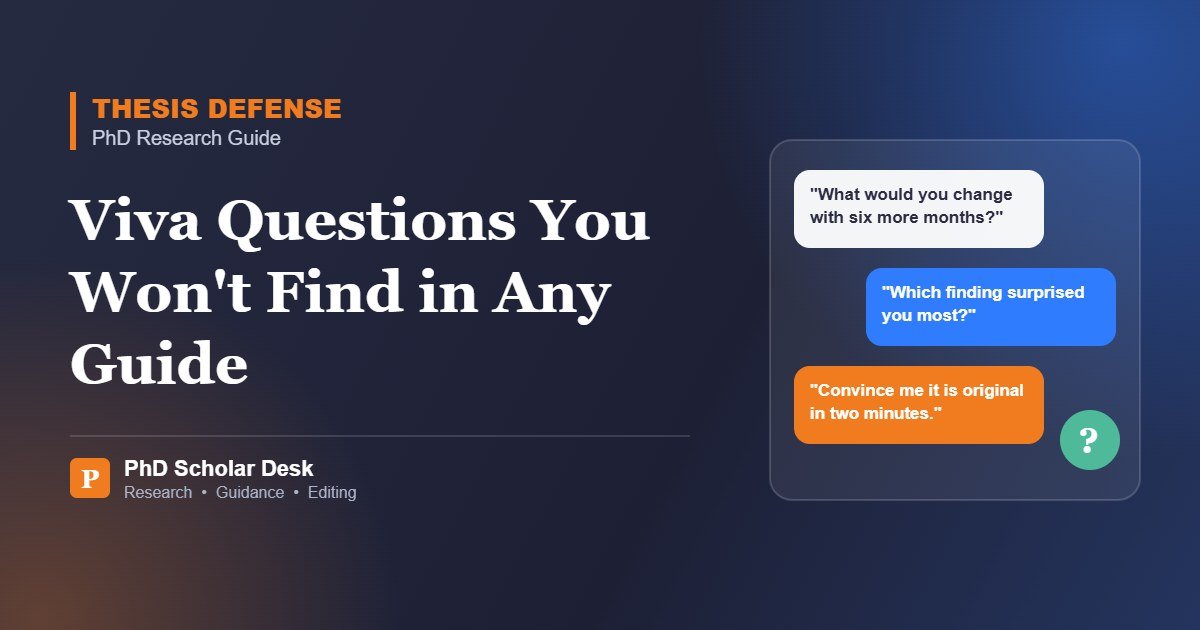
Thesis Defense Questions You Won’t Find in Any Guide (Real Questions Students Were Actually Asked in Their Viva)
The difficult follow-up questions examiners really ask in Master’s and PhD vivas, what each one tests, and how to prepare for the unexpected.
Key takeaways
- Examiners test critical thinking and research ownership, not memorised answers.
- Methodology questions are often the longest part of a defense.
- Expect “stress test” questions that challenge your originality and assumptions.
- Prepare by reviewing the decisions you made, not by rehearsing long speeches.
Most blogs about thesis defenses list the same predictable questions: “What is your research objective?” or “Why did you choose this topic?” Those questions do appear, but many students are surprised by the follow-up questions examiners ask during real Master’s and PhD defenses. These questions test critical thinking, research ownership and the ability to defend decisions under pressure, not memorised answers.
Below are examples of challenging thesis defense questions that students across business, social sciences, engineering, healthcare and the humanities have commonly reported being asked in real viva examinations.
The questions that catch students off guard
1. “If you had six more months, what would you change in this research?”
This tests whether you recognise the limitations of your own study and can identify realistic improvements.
2. “Which finding surprised you the most, and why?”
Examiners want to know whether you genuinely analysed your results instead of simply reporting them.
3. “What evidence would convince you that your conclusion is wrong?”
This measures your academic objectivity and willingness to consider alternative interpretations.
4. “Why should anyone care about this research five years from now?”
A strong answer connects the study to long-term academic, industry or policy relevance.
Questions about your methodology
These often become the longest part of a defense.
| Question | What the examiner is testing |
|---|---|
| Why did you reject other research methods? | Justification of methodological choices |
| What assumptions did your methodology make? | Understanding of research design |
| How did you reduce bias during data collection? | Research credibility and ethics |
| If your sample doubled, would your conclusions change? | Reliability and generalisability |
| What is the biggest weakness in your methodology? | Critical self-evaluation |
The best responses acknowledge limitations while explaining why the chosen method was still appropriate for the research objectives. Many of these questions trace back to choices made in your research proposal and data collection stage.
Questions based on your results
Examiners often focus on interpretation rather than statistics or data:
- Which result is the strongest evidence supporting your argument?
- Which finding contradicts previous literature?
- Why do two of your findings appear inconsistent?
- Could these results be explained differently?
- What result did you expect but never found?
These questions assess whether you understand the story behind the data rather than simply presenting tables or themes.
The “stress test” questions
These questions deliberately challenge your confidence.
“Convince me your research is original in two minutes.”
A concise explanation of the research gap is more effective than summarising the entire thesis. A well-structured literature review makes this gap much easier to defend.
“What is the hardest criticism someone could make of your thesis?”
Examiners want to see intellectual maturity, not perfection.
“What would happen if your main hypothesis or argument did not hold?”
This checks whether your conclusions depend entirely on one assumption.
Field-specific viva questions students report
Business and management
- Why did you choose this theoretical framework instead of another competing theory?
- How can organisations apply your recommendations in practice?
- Are your findings relevant outside your chosen country or industry?
Social sciences
- How did your own perspective influence data interpretation?
- Why did participants trust you with sensitive information?
- Would another researcher identify the same themes?
Engineering and technology
- Why is your proposed model better than existing alternatives?
- What are the implementation challenges in real-world settings?
- How would your system perform under different conditions?
Health and medical research
- How do ethical considerations affect the validity of your findings?
- Would your recommendations change for another patient population?
- Which variable had the greatest influence on your results?
How to prepare for unexpected defense questions
Instead of memorising answers, prepare by reviewing the decisions you made throughout your thesis. Be ready to explain why you selected a research design, how you interpreted findings, what limitations remain and where future research should go. Practising short, evidence-based responses is often more effective than rehearsing long speeches. Before submission, a final editing and proofreading check also removes the small errors examiners notice.
Final thoughts
A successful thesis defense is rarely about answering every question perfectly. It is about demonstrating ownership of your research and responding thoughtfully when challenged. The most difficult viva questions are usually follow-up questions that explore your reasoning, not your memory. Preparing for these real-world questions will leave you far better equipped than relying on generic thesis defense guides alone.
Preparing for your viva?
Talk to a research expert about your thesis, your methodology and the questions you are worried about.
Keep reading
This guide is for learning and planning. Requirements vary by university, so always check your programme handbook and supervisor’s expectations. Any work you submit must be your own, with every source properly attributed.

One response
[…] VivaThesis Defense Questions You Won’t Find in Any GuideDissertationHow to Write a Dissertation: A Complete Step-by-Step Guide […]