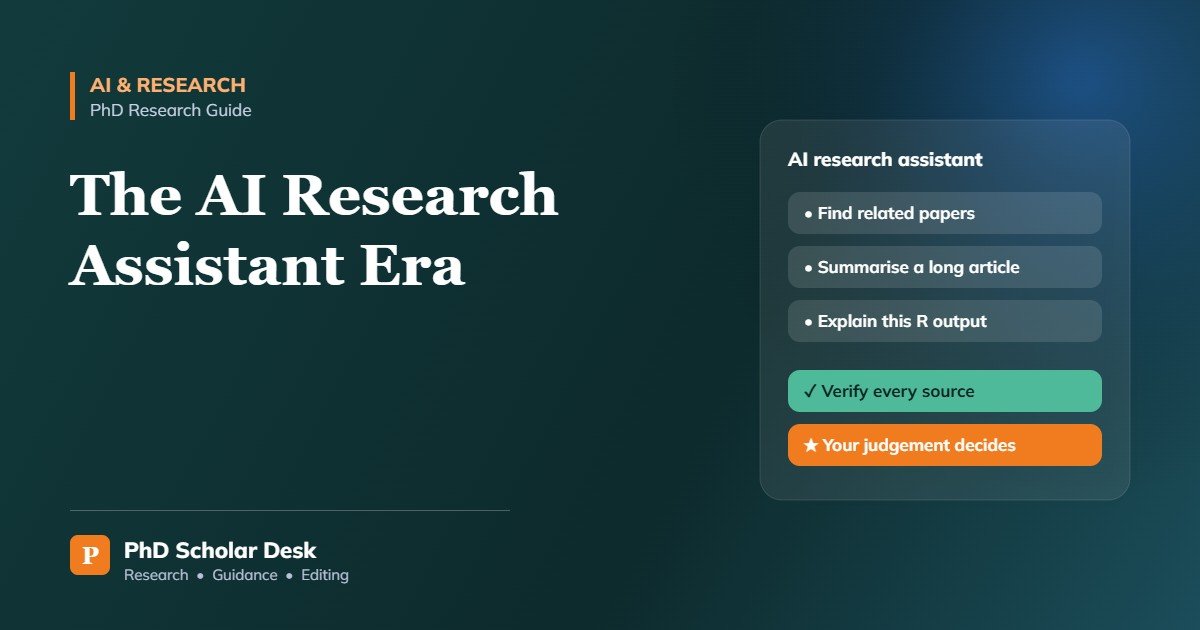
The AI Research Assistant Era: What Changes for PhD Scholars
AI tools can now search literature, summarise papers, explain statistics and help with code. Here is how to use them well, where the risks are, and which parts of research must stay firmly human.
Key takeaways
- AI can speed up discovery, reading, coding and editing.
- Judgement, originality and accountability remain the researcher’s job.
- Verify every AI-suggested source and never upload sensitive data carelessly.
- Keep a record of AI use and follow your university’s disclosure rules.
A few years ago, a PhD scholar’s toolkit meant databases, a reference manager and statistical software. Today, many researchers also use AI assistants to find related studies, summarise long papers, explain unfamiliar methods and debug analysis code. This is a genuine shift in how research gets done, and it brings both opportunities and new responsibilities.
What has changed
AI assistants have moved from novelty to everyday tools. Research-focused platforms such as Elicit, Consensus, SciSpace and ResearchRabbit help with literature discovery and reading, while general assistants such as ChatGPT help explain concepts, draft outlines and review code. Universities and journals have responded with new policies on what is allowed and what must be disclosed.
Where AI helps in a PhD
| Research stage | How AI can help | Your responsibility |
|---|---|---|
| Literature discovery | Find related papers and map citation networks | Search proper databases and judge relevance |
| Reading | Summarise papers and explain difficult sections | Read key papers in full and check accuracy |
| Methods and analysis | Explain techniques and help debug R or Python code | Choose the method and understand every result |
| Writing | Suggest structure and improve clarity of your own drafts | Write the argument and analysis yourself |
| Referencing | Help format citations | Confirm every reference exists and is correct |
Used this way, AI saves time on repetitive work so you can spend more of it on thinking. If you are building a review, our guide on conducting a systematic literature review shows where structured methods still matter most.
What must stay human
Research questions
Deciding what is worth studying and why requires subject knowledge and judgement.
Critical evaluation
Weighing the quality of evidence and spotting weak studies is a core research skill.
Original contribution
Your thesis must show your own thinking, interpretation and argument.
Ethics and accountability
You are responsible for your data, methods and every claim you make.
The risks to manage
- Invented or wrong references. General AI assistants can produce citations that do not exist or misstate what a paper found.
- Data privacy. Uploading confidential, unpublished or participant data to public tools may breach ethics approval or data protection rules.
- Over-reliance. Letting AI summarise everything can leave gaps in your understanding that examiners will notice in your viva.
- Integrity breaches. Submitting AI-generated text or analysis as your own work can count as misconduct.
A responsible AI workflow
- Check the rules first. Read your university, department and funder policies on AI use.
- Use AI to explore, not to conclude. Let it suggest papers and ideas, then verify them in databases and full texts.
- Protect your data. Keep sensitive data out of public tools unless your approvals allow it.
- Keep a simple log. Note which tool you used, for what and when; it makes disclosure easy.
- Write the analysis yourself. Use AI feedback to improve clarity, not to replace your reasoning.
Skills that matter more now
As AI handles more routine tasks, the skills that set strong researchers apart are becoming more visible: asking precise questions, evaluating evidence, explaining methods clearly, and writing an argument that is genuinely your own. These are also the skills examiners test in a thesis defense.
The bottom line: AI is a powerful research assistant, but it is still an assistant. The value of a PhD lies in the judgement and originality you bring to it.
Frequently asked questions
Can I use AI tools for my PhD research?
Often yes, for support tasks such as finding papers, explaining concepts or checking code, but rules vary. Check your university and funder policies, and never present AI-generated text or analysis as your own work.
Is it safe to upload my data to AI tools?
Be careful. Do not upload confidential, unpublished or participant data to public AI tools unless your ethics approval and data management plan allow it.
Do I need to disclose AI use in my thesis?
Many universities and journals now expect disclosure of AI use beyond basic spelling or grammar help. Follow your institution’s guidance and keep a record of how you used each tool.
Will AI replace research supervisors?
No. AI can speed up some tasks, but supervisors provide judgement, subject expertise, ethical guidance and academic mentoring that tools cannot replace.
Want expert support alongside your tools?
Our research specialists help with methodology, analysis and thesis structure, so the decisions in your research are sound and defensible.
Keep reading
This guide is for learning and planning. Requirements vary by university, so always check your programme handbook and supervisor’s expectations. Any work you submit must be your own, with every source properly attributed.

No responses yet